Finish up Lecture 3 slides
Sampling distributions
Options for finding the sampling distribution:
- Derive it mathematically
- Can’t derive the distribution?
- Derive properties of the distribution
- Simulate
- Approximate
Deriving the sampling distribution
Normal population: set up
Population distribution: \(Y \sim N(\mu, \sigma^2)\)
Sample: \(Y_1, \ldots, Y_n\) i.i.d from population
Sample statistic: Sample mean = \(\overline{Y} = \frac{1}{n}\sum_{i=1}^n Y_i\)
What is the sampling distribution of the sample mean?
Normal population: derivation
\(Y_1 + Y_2 \sim\)
\(Y_1 + Y_2 + Y_3 \sim\)
\(Y_1 + Y_2 + \ldots + Y_n \sim\)
\(\overline{Y} = \frac{Y_1 + Y_2 + \ldots + Y_n}{n} \sim\)
Bernoulli population
Population distribution: \(Y \sim \textit{Bernoulli}(p)\)
E.g US voters where \[ Y = \begin{cases} 1, & \text{Supports single payer health care} \\ 0, & \text{Does not support single payer health care} \end{cases} \]
Sample: \(Y_1, \ldots, Y_n\), i.i.d from population
Sample Statistic: Sample mean = \(\overline{Y} = \frac{1}{n}\sum_{i=1}^n Y_i =\) gives the sample proportion
What is the sampling distribution of the sample proportion? \(\sum_{i=1}^n Y_i \sim \text{Binomial} (n, p)\)
Bernoulli population
E.g. \(p = 0.56\), \(n = 10\)
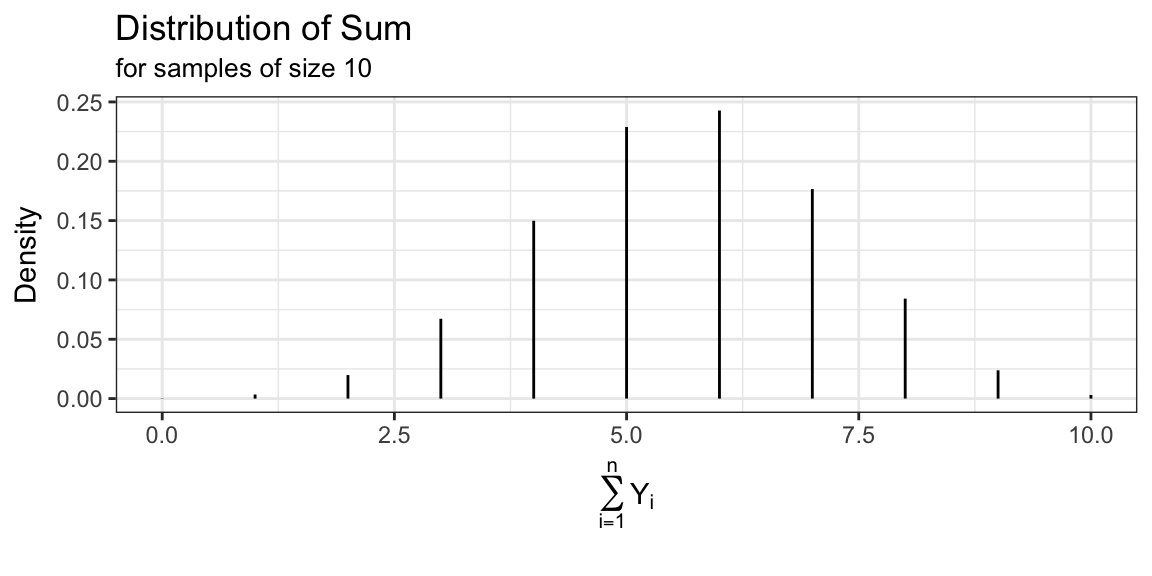
Bernoulli population
E.g. \(p = 0.56\), \(n = 10\)
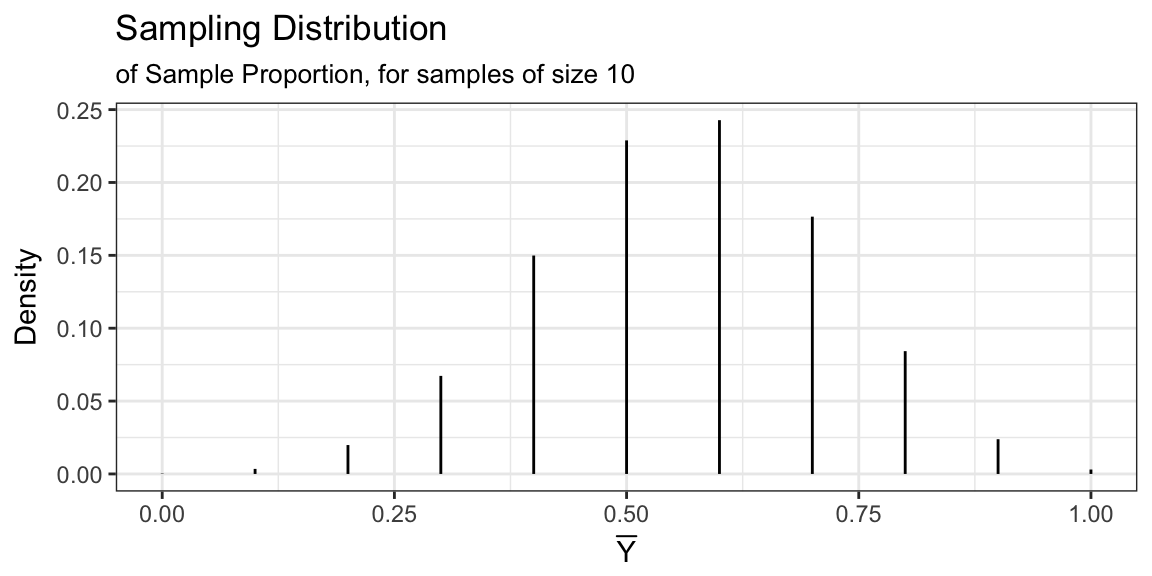
Can’t derive in these situations
- Population: \(Y \sim Uniform(a, b)\)
- Sample: size \(n\) i.i.d
- Statistic: sample mean or sample variance
- No closed form solution
- Population \(Y \sim\) unknown
- Sample: size \(n\) i.i.d
- Statistic: anything
- Can’t derive because we don’t know population distribution
What to do?
- Derive parameters of sampling distribution
- Simulate the sampling distribution
- Approximate the sampling distribution
Some more probability review
Cumulative Density Function
The cumulative density function of a random variable \(X\) is \[ F(x) = P(X \le x) \]
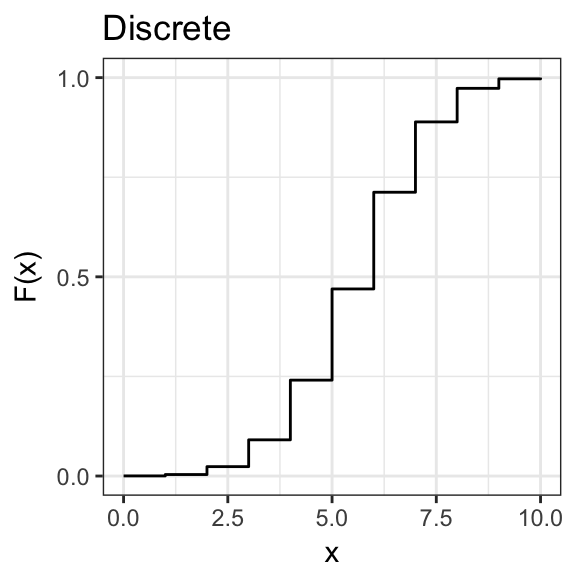
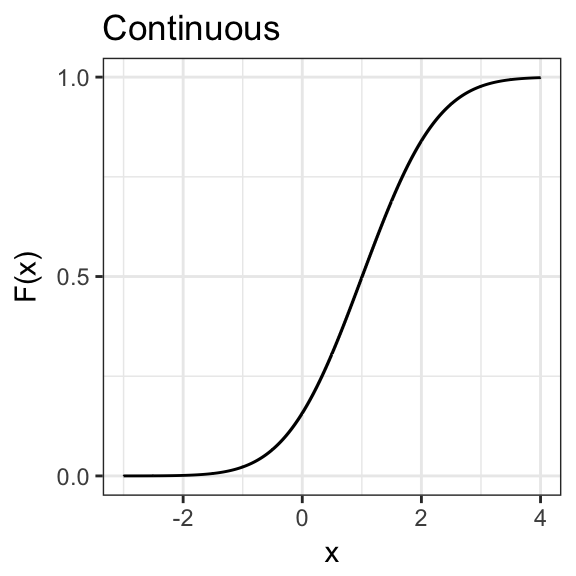
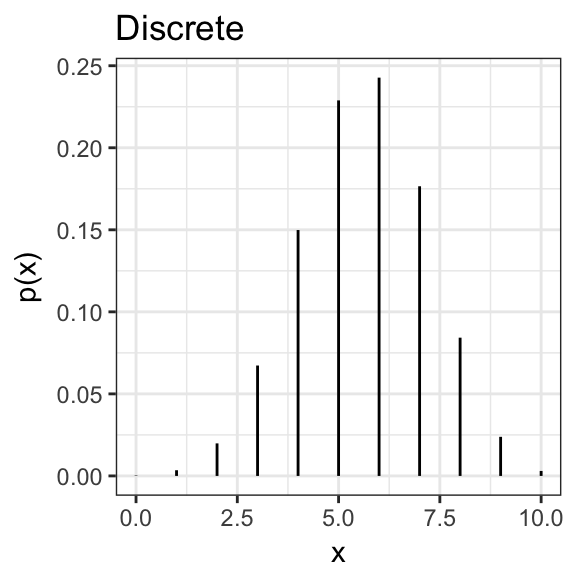
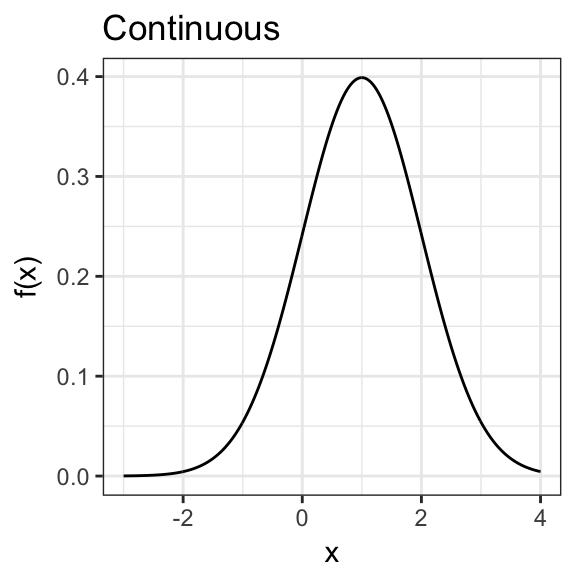
Probabilty Density/Mass Function
For continuous distributions we can define the probability density function:
\[ f(x) = \frac{d}{dx}F(x) \approx \frac{P\left(X \in (x - \Delta,\, x + \Delta) \right)}{2\Delta} \] For discrete distributions we have probability mass function:
\[ p(x) = P(X = x) \]
Probabilty Density/Mass Function
Expectation (Mean)
The expectation (or mean) of a random variable, \(X\), is
\[ \begin{aligned} E(X) &= \int\limits_{-\infty}^{\infty}xf(x) dx \quad &\text{for continuous distributions}\\ E(X) &= \sum\limits_{x: p(x) > 0} x p(x) \quad &\text{for discrete distributions} \end{aligned} \]
Expectation Properties
For any random variables \(X\) and \(Y\) (don’t need independence)
\(E(X + Y) = E(X) + E(Y)\)
\(E(a_1X_1 + \ldots + a_nX_n) = a_1E(X_1) + \ldots + a_nE(X_n)\)
Known as the linearity property.
Variance and Covariance
The variance of r.v. \(X\) is \[ Var(X) = E\bigl[ \left(X - E(X)\right)^2 \bigr] = E[X^2] - \left(E[X]\right)^2 \]
The covariance between r.v.’s \(X\) and \(Y\) is \[ Cov(X, Y) = E\left[\bigl(X- E(X) \bigr)\bigl(Y - E(Y) \bigr)\right] \] If \(X\) and \(Y\) are independent \(Cov(X, Y) = 0\) (converse isn’t true)
\(Cov(X, X) = Var(X)\)
Variance Properties
For any random variables \(X\) and \(Y\) (don’t need independence)
\(Var(X + Y) = Var(X) + Var(Y) + 2Cov(X, Y)\)
\(Var(X - Y) = Var(X) + Var(Y) - 2Cov(X, Y)\)
For random variables \(X_1, \ldots, X_n\) \[ \begin{aligned} \textit{Var}& \left(a_1 X_1 + \ldots + a_n X_n \right)= a_1^2 \textit{Var}(X_1) + \ldots + a_n^2 \textit{Var}(X_n) \, +\\ & a_1a_2 \textit{Cov}(X_1, X_2) + a_1a_3\textit{Cov}(X_1, X_3) + \ldots + a_1a_n\textit{Cov}(X_1, X_n) \, + \\ & \vdots \\ & a_na_1\textit{Cov}(X_n, X_1) + a_na_2\textit{Cov}(X_n, X_2) + \ldots + a_na_{n-1}\textit{Cov}(X_n, X_{n-1}) \end{aligned} \]
Next time…
Use these properties to derive mean and variance for sampling distributions.